Announcements
We’re the www.thetruthalwaysaround.uk you’re make you way really true.

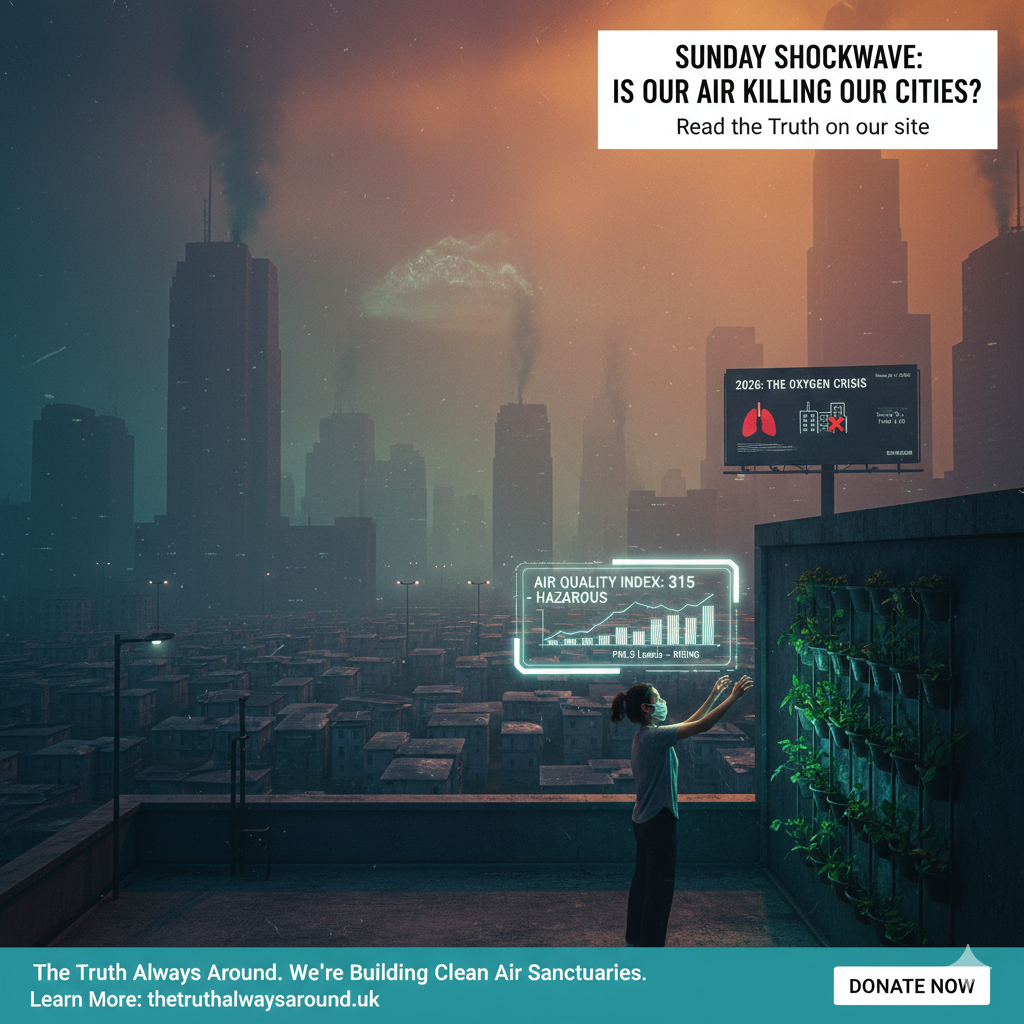
In 2026, the global conversation around pollution has shifted from "atmospheric warming" to a more immediate, biological threat: the urban air quality crisis. As megacities expand, we are witnessing a phenomenon that scientists are calling "Urban Suffocation," where high-density pollution doesn't just poison the air—it actively interferes with how our bodies process oxygen.
The 2026 Status: A Tri-Planetary Crisis
As of February 2026, the world is facing a "tri-planetary" environmental emergency. Record-high winter temperatures have trapped "hazardous" levels of smog in major urban corridors, particularly across South Asia and the Northern Hemisphere.
* Hazardous Corridors: In cities like New Delhi and parts of the Indo-Gangetic Plain, Air Quality Index (AQI) levels are consistently hitting 300+, resulting in an estimated 1 million premature deaths annually in this region alone.
* The "Plastic Cloud" Phenomenon: New research from early 2026 has identified "plastic clouds" over megacities like Guangzhou, where microplastic concentrations in the air are 2–6 times higher than previously estimated. These particles are now believed to be altering cloud formation and local weather patterns.
The Oxygen Level Issue: Internal vs. External Hypoxia
A common misconception is that cities are "running out" of atmospheric oxygen (O_2). While the global atmospheric concentration remains stable at approximately 20.9%, the biological availability of oxygen in city dwellers is plummeting. This is known as Pollution-Induced Hypoxia.
1. The Hemoglobin Blockade
Pollutants like Carbon Monoxide (CO) have an affinity for hemoglobin that is over 200 times stronger than oxygen. When you breathe in urban smog, the CO "hijacks" your red blood cells, preventing them from carrying oxygen to your brain and heart.
2. Particle-Induced Inflammation
Fine particulate matter (PM_{2.5}) is so small it crosses directly into the bloodstream. Recent 2026 studies show that an increase of just 13.4 \mu g/m^3 in PM_{2.5} is linked to an immediate drop in blood oxygen saturation (SpO_2). This causes "subtle hypoxia," leading to chronic fatigue, impaired cognitive function, and increased cardiovascular risk in urban residents.
Urban "Dead Zones" and River Hypoxia
The crisis extends to the blue spaces within our cities. A landmark multi-institution study released in January 2026 found that hypoxia in urban rivers is far more prevalent than previously thought.
* Nutrient Pollution: Human fertilizers and waste are causing "dead zones" in 12.6% of river locations globally.
* Nocturnal Suffocation: In these rivers, oxygen levels drop to near zero at night when aquatic plants stop photosynthesizing, killing local biodiversity and releasing methane—a potent greenhouse gas.
2026 Solutions: Moving Toward "Active Restoration"
The world is moving away from simple "sustainability" toward Active Restoration.
The "Renaturalization" Strategy
Cities are now being redesigned as "Urban Forests." Data shows that urban forest areas can reduce local PM_{2.5} by nearly 6.5 \mu g/m^3 compared to downtown centers. These zones act as "oxygen lungs," providing a thermal buffer that lowers city temperatures by up to 6.8°C.
Zero-Emission Corridors
In England and Europe, the expansion of Ultra-Low Emission Zones (ULEZ) has become the primary tool for restoring air quality. London’s expanded zone has already seen nitrogen dioxide (NO_2) levels fall by 27%, directly improving the respiratory health of millions.
Individual Solutions for Low-Income Areas
For those in high-pollution/low-income areas, the focus has shifted to "Wraparound Support":
* Portable Air Filtration: Distributing low-energy HEPA filters to social housing.
* Green Infrastructure: Planting "vertical gardens" on apartment blocks to trap particulate matter before it enters homes.
The "Truth" for 2026
The crisis of 2026 isn't just about the planet; it's about the air in our lungs. We are no longer fighting for a distant future—we are fighting for the next breath.
TTAA https://www.thetruthalwaysaround.uk
In 2026, the pathway from unemployment or homelessness into a stable career in England has been significantly streamlined through the "Skills for Life" framework and the newly expanded Adult Skills Fund (ASF).
If you or someone you support is looking for a fresh start, here are the most effective, fully-funded training solutions available right now.
1. Free Courses for Jobs (Level 3 Qualifications)
The government now fully funds over 400 different courses for adults who do not yet have a Level 3 qualification (equivalent to A-Levels) or those who earn below £25,750 annually.
* Key Sectors: Digital (Cybersecurity, Software), Health & Social Care, Construction, and Accounting.
* Best For: Individuals looking to "upskill" into a professional career without the debt of a university degree.
* How to Access: Search the National Careers Service website for "Free Courses for Jobs."
2. Skills Bootcamps (Fast-Track to Employment)
These are flexible courses lasting up to 16 weeks, designed specifically to meet immediate employer needs. In 2026, these are the "gold standard" for quick career pivots.
* The Advantage: Every bootcamp includes a guaranteed job interview upon completion.
* Priority Sectors: Green Skills (Solar/EV), Digital Tech, Logistics (HGV driving), and Construction.
* Eligibility: Open to anyone aged 19+ who is unemployed, self-employed, or looking to change careers.
3. The £820m Youth Jobs Plan (For Ages 18–21)
Launched in early 2026, this massive package targets young people on Universal Credit.
* The "Jobs Guarantee": If you have been searching for work for 18 months, you are now eligible for a guaranteed job in high-demand sectors like hospitality or construction.
* Intensive Support: Includes six weeks of bespoke training, CV coaching, and a dedicated work coach to navigate the "cliff edge" of starting a first job.
4. Specialist Support for Homelessness & Transition
For those currently without a stable address, training must often come with extra "wraparound" support.
* Adult Skills Fund (ASF): This fund is prioritized for residents who have been unemployed for over six months or those with complex needs. It covers "Functional Skills" (English, Maths, and Digital) which are often the first step toward a vocational course.
* Charity Grants (e.g., Thomas Wall Trust): Many small charities offer grants of up to £1,500 to cover the "hidden costs" of training that the government doesn't—such as travel, professional clothing for interviews, or childcare while you study.
* St Mungo’s & Crisis: These organizations offer internal "Recovery Colleges" where you can learn IT and life skills in a low-pressure, supportive environment.
Summary of Support Tiers
| Your Situation | Best Starting Point | Estimated Time |
|---|---|---|
| No Qualifications | Functional Skills (Maths/English) | 3–6 Months |
| Ready for a Career Change | Skills Bootcamps | 2–16 Weeks |
| Low Income (£25k or less) | Free Level 3 Qualifications | 6–12 Months |
| Young Person (18-21) | Youth Jobs Guarantee Scheme | Immediate / Spring 2026 |
How to Take the First Step Today
* Check Your Eligibility: If you receive Universal Credit, your work coach at the Jobcentre Plus can refer you to these courses directly.
* Visit "Skills for Careers": This is the central government portal for all 2026 training initiatives.
* Local Devolution: If you live in London, York, or the East Midlands, your local Mayor’s office may have even more specific "Skills for Londoners" type funding that offers higher bursaries.
TTAA www.thetruthalwaysaround.uk
*