Announcements
1. The "Skills-First" Revolution: Beyond the Degree
In 2026, the traditional university degree is losing its status as the primary gatekeeper to employment. A massive trend called "Skills-Based Hiring" has become mainstream across the UK and the US.
* Micro-Credentials: Job seekers are increasingly using "stackable" certifications from boot camps and digital platforms (like Salesforce’s Trailhead or Google Certificates) to prove competency in weeks rather than years.
* The "Human-Centric" Pivot: As AI automates routine cognitive tasks, employers are prioritizing skills that machines struggle to replicate: Leadership, Curiosity, and Resilience.
* Sector Growth: Demand for experienced talent is highest in healthcare, advanced manufacturing, and professional services, where "soft skills" and technical expertise overlap.
2. The Green "Twin Transition": Sustainability Meets AI
The "Green Economy" is no longer a niche sector. In 2026, "green skills" are becoming a baseline expectation for almost every job, from procurement to project management.
* Electrification & Clean Power: One in three hires in the utility sector is now a "green hire."
* Green AI: A new trend involves workers using AI to run low-carbon systems—optimizing energy grids or managing sustainable supply chains.
* Top 2026 Green Careers: * Renewable Energy Technicians
* EV (Electric Vehicle) Specialists
* ESG (Environmental, Social, and Governance) Strategists
* Climate Data Analysts
3. The AI "Net-Positive" Paradox
While 2025 saw significant layoffs in the tech sector, 2026 is emerging as a year of "AI-Driven Hiring." Despite the fear of displacement, CEOs are predicting a boom in entry-level roles for those who can work with AI.
* The "Global Jobs Gap": While headline unemployment remains stable at around 4.9%, the "jobs gap"—those who want work but can't access it—is projected to reach 408 million globally.
* Labor Hoarding vs. Shedding: Many firms are currently "hoarding" labor (keeping staff despite slowing revenue) to avoid the hiring struggles seen post-pandemic, but this is shifting toward strategic, AI-augmented hiring.
* Support Innovation: In the UK, the government is proposing a new "Unemployment Insurance" (UI) benefit. This would replace older jobseeker's allowances with a higher, time-limited payment designed to give newly unemployed people the financial "breathing room" to reskill for AI roles.
Summary of Key Solutions in 2026
| Solution Type | Target Area | Key Initiative |
|---|---|---|
| Financial | Social Safety Net | Proposed UK Unemployment Insurance (UI) |
| Educational | Lifelong Learning | World Economic Forum’s "Reskilling Revolution" |
| Logistical | Workplace Access | Transportation solutions (vanpools, car repair aid) to reduce absenteeism |
| Technological | Productivity | "Agentic AI" tools that act as virtual co-workers |
AI jobs boom explains why CEOs expect a hiring surge this year despite the layoffs seen in 2025.
https://youtu.be/YoQAeYsYcZM
*
- TTAA was founded by a team of social advocates who saw the gaps in the traditional support system.
We realized that while many services exist, they often lack the transparency and long-term commitment needed to break the cycle of poverty.
Fundraisers our way https://donate.stripe.com/fZu4gAcix9BefKz5V2dfG01

As we launch the TTAA Hub project, we must look squarely at the "Truth" of the environment we are operating in. The reality of homelessness in England today has shifted from a social issue to a national emergency.
The Current Status: A Record-Breaking Crisis
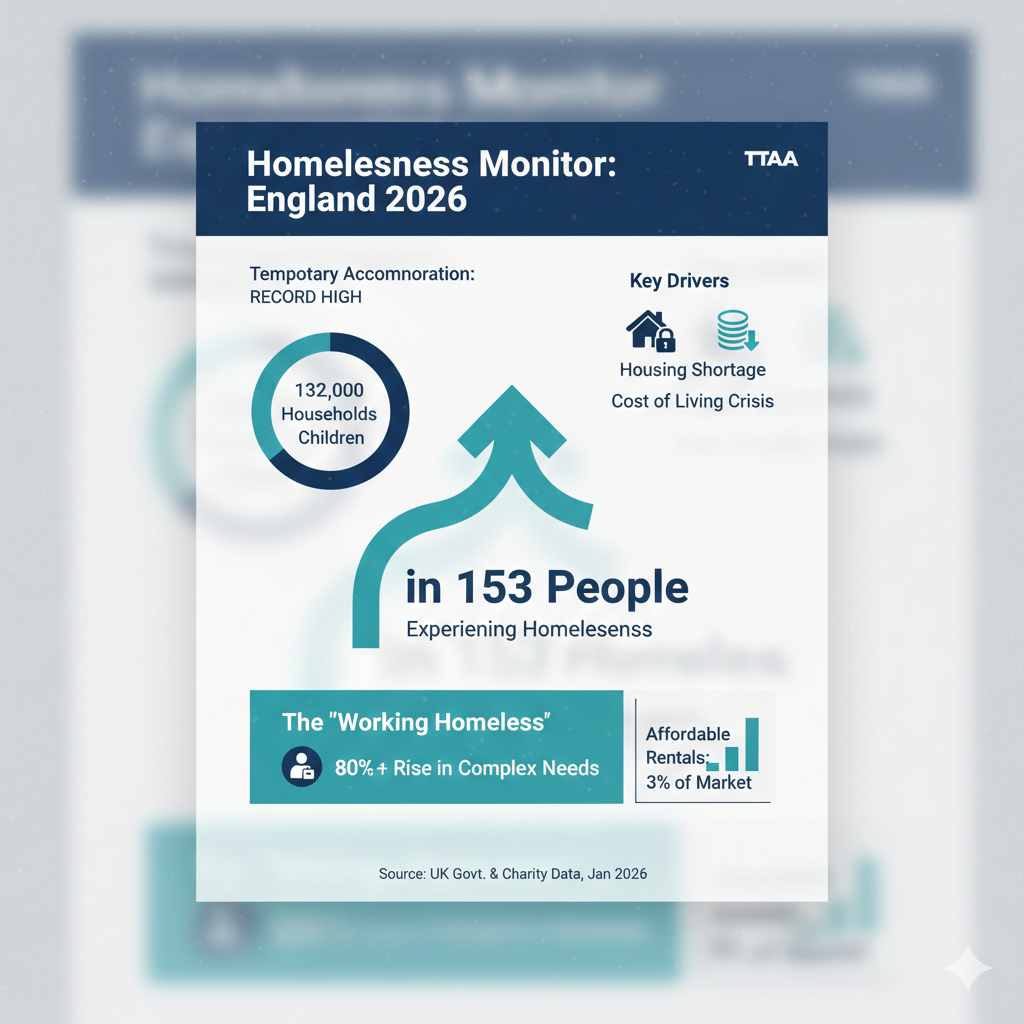
As of January 2026, homelessness in England has reached levels unseen in decades. Driven by a persistent housing shortage and the long-tail effects of the cost-of-living crisis, the statistics tell a sobering story:
* Temporary Accommodation at a Breaking Point: Over 132,000 households—including more than 172,000 children—are currently living in temporary accommodation. This is the highest figure on record.
* The Scale of the Issue: Recent data indicates that approximately 1 in every 153 people in England is currently experiencing some form of homelessness, whether rough sleeping, sofa surfing, or staying in unsuitable hostels.
* A "New Face" of Homelessness: We are seeing a sharp rise in "working homeless"—individuals who have full-time jobs but cannot afford the skyrocketing private rents, which now cover only about 3% of available properties for those on benefits.
The "Cons": Why Current Support is Failing
While billions are spent annually, the "support" system often feels like a revolving door. To solve the problem, we must acknowledge the "cons" and challenges of the current approach:
1. The "Firefighting" Trap
Most government funding is reactive. Local authorities are forced to spend the majority of their budgets on emergency temporary accommodation (like expensive B&Bs) rather than long-term prevention. This keeps people in a state of limbo rather than moving them toward independence.
2. The "Cliff Edge" of Institutional Discharge
A major contributor to street homelessness is the lack of "joined-up" support. People are still being discharged from hospitals, prisons, and asylum seeker accommodation with no clear pathway, effectively being "released into homelessness."
3. The Stigma of "Benefit-Friendly" Housing
There is a massive barrier for those trying to secure a home: many private landlords still refuse to accept tenants receiving Universal Credit. Even with a deposit, the "system" often locks people out based on their status rather than their potential.
4. Complex Needs vs. Simple Solutions
The sector has seen an 80%+ rise in people presenting with complex mental health and trauma needs. Simply providing a bed (a "handout") is no longer enough; without the "hand up" of mentorship and professional reintegration, the cycle continues.
Our Response: The TTAA Way
At The Truth Always Around, we believe the solution lies in re-professionalisation. We are not just another temporary fix. By building the TTAA Hub, we are addressing the "Cons" head-on:
* Instead of Limbo: We provide a Tech Lab for career skills.
* Instead of Stigma: We provide a Work-Ready Wardrobe to restore professional identity.
* Instead of Isolation: We provide a Community Hub that offers the mentorship the current system lacks.
The situation in England is dire, but the blueprint for change is ready. It starts with a Hub. Support link >>>> click now our link <<<<
*Data approximate largest cities in England 2026